By Asif KhalidPublished: Last updated:
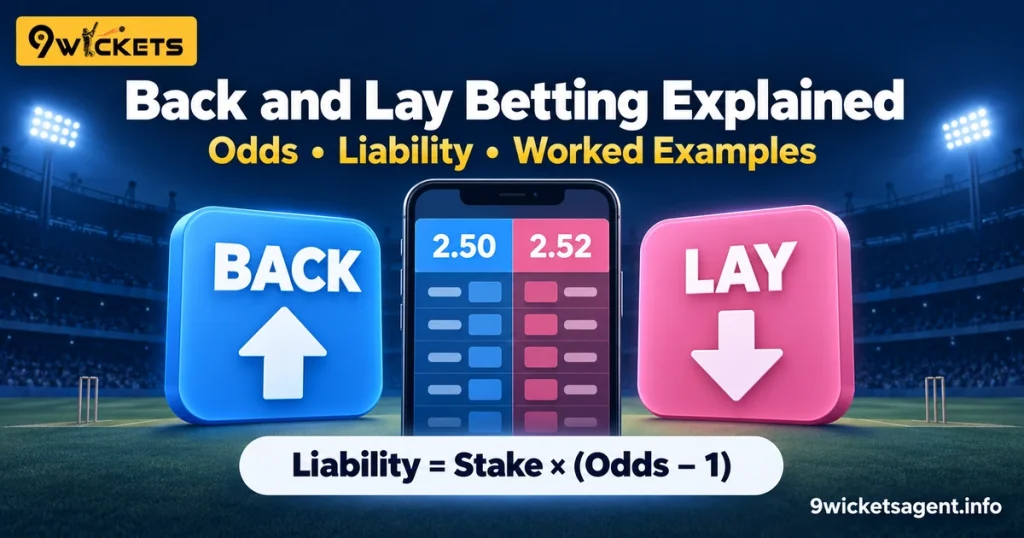
Quick answer: in back and lay betting, a back bet is a bet that something will happen, and a lay bet is a bet that it will not happen. On a betting exchange, one user backs and another user lays at the same odds. If you back, your risk is your stake. If you lay, your risk is called liability, which equals your lay stake multiplied by the odds minus one.
Back and lay betting is the core idea behind every betting exchange, yet many new users only ever see a blue “Back” column and a pink “Lay” column without knowing what separates them. This guide explains both sides in plain language, shows the maths with worked examples, covers liability and commission, and compares exchanges with traditional bookmakers. It also explains the informal terms lagai and khai that cricket followers in South Asia often use for the same two sides.
What Is Back and Lay Betting?
A back bet supports an outcome. If you back Bangladesh to win a match, you win when Bangladesh wins. A lay bet opposes an outcome. If you lay Bangladesh, you win when Bangladesh does not win, which includes a loss, and in some markets a draw or tie.
With a normal bookmaker you can only back. The bookmaker sets the odds and takes the other side of every bet. A betting exchange works differently: it matches users against each other, so one person’s back bet is another person’s lay bet. The exchange simply holds the money and charges a commission on winnings.
If you are new to the vocabulary used around odds, stakes and markets, our glossary of common cricket betting terms is a useful companion to this guide.
Back vs Lay: The Difference in One Table
| Point | Back bet | Lay bet |
|---|---|---|
| What you predict | The outcome will happen | The outcome will not happen |
| Your role | Punter | Acting like the bookmaker |
| Maximum loss | Your stake | Your liability: stake × (odds − 1) |
| Maximum profit | Stake × (odds − 1) | The backer’s stake you accepted |
| Effect of higher odds | Bigger potential profit | Bigger potential loss |
| Informal South Asian term | Lagai | Khai |
How Exchange Odds Work
Exchanges usually display decimal odds. Decimal odds include your stake, so odds of 2.50 mean a winning 100-unit back bet returns 250 units in total: 150 units profit plus the 100-unit stake.
Decimal odds also show the implied probability. Divide 1 by the odds and multiply by 100. Odds of 2.50 imply a 40 percent chance, and odds of 1.25 imply an 80 percent chance. On an exchange you will see the best available back price and the best available lay price side by side. The small gap between them is called the spread, and it narrows in busy markets with plenty of money waiting to be matched. If these ideas are completely new, our beginner’s guide for first-time users covers the basics first.
Worked Example: Backing a Team
Imagine a one-day match between Bangladesh and West Indies. Bangladesh are available to back at 2.50, and you back them for 100 units.
- If Bangladesh win: profit = 100 × (2.50 − 1) = 150 units, before commission.
- If Bangladesh do not win: you lose your 100-unit stake.
This works exactly like a bookmaker bet. The only difference is that another exchange user, not a company, accepted the other side. Your stake leaves your balance as soon as the bet is matched, so it helps to know how money reaches an account in the first place; our overview of available deposit methods lists the main wallets.
Worked Example: Laying a Team and Liability Explained
Now take the opposite view. You think Bangladesh will not win, so you lay them at 2.50 with a lay stake of 100 units. You are accepting another user’s 100-unit back bet.
- Liability = 100 × (2.50 − 1) = 150 units. The exchange reserves this amount from your balance when the bet is matched.
- If Bangladesh do not win: you win the backer’s 100 units, before commission.
- If Bangladesh win: you pay the backer’s 150 units profit, which is your full liability.
Why Liability Grows With the Odds
Liability depends on the odds, not just the stake. Laying an outsider is far riskier than laying a favourite, even with the same stake:
| Lay odds | Lay stake | Liability | Profit if the selection loses |
|---|---|---|---|
| 1.50 | 100 | 50 | 100 |
| 2.50 | 100 | 150 | 100 |
| 5.00 | 100 | 400 | 100 |
| 11.00 | 100 | 1,000 | 100 |
Many new exchange users only look at the lay stake and forget the liability. Always check the liability figure shown on the bet slip before you confirm.
Lagai and Khai: The Local Terms for Back and Lay
In cricket conversations across Bangladesh, India and Pakistan, people often use two informal words. Lagai usually refers to taking the favourite, which matches the idea of backing. Khai usually refers to going against the favourite, which matches the idea of laying. These are colloquial terms rather than official exchange labels, and their use can vary between regions and groups, so always rely on the “Back” and “Lay” columns on the platform itself.
Rates quoted in this style move quickly during a live match, especially after wickets or big overs. Following the game closely through fast live cricket score updates helps you understand why prices shift. A good primer on following a cricket match through live scores explains which numbers matter most during an innings.
Exchange vs Bookmaker: Key Differences
| Feature | Betting exchange | Traditional bookmaker |
|---|---|---|
| Who sets the odds | Users, through supply and demand | The bookmaker |
| Lay betting | Available | Not available |
| How it earns | Commission on net winnings | Margin built into the odds |
| Odds | Often closer to true probability | Include the bookmaker’s margin |
| Bet acceptance | Needs a matching user | Accepted by the bookmaker directly |
Commission rates differ between exchanges and sometimes between customers, so check the platform’s own rules. Commission is usually charged only on net winnings in a market, not on losing bets. On platforms that work through an agent network rather than a pure exchange, the agent structure decides who handles accounts and settlements; the master agent role explained guide shows how that layer works.
Back to Lay Trading: Locking In a Result
Because you can both back and lay the same selection, prices can be traded like a market. The idea is to back at higher odds and lay later at lower odds, or the reverse. The Sporting Life guide to back-to-lay and lay-to-back covers this approach in more detail.
Example: you back a team for 100 units at 3.00. Their position improves and the price falls to 2.00. You lay them for 150 units at 2.00, calculated as back stake × back odds ÷ lay odds.
- If the team wins: back profit +200, lay loss −150, net +50 units.
- If the team does not win: back loss −100, lay profit +150, net +50 units.
The same result either way, before commission. The reverse also happens: if the price moves against you, a trade can lock in a smaller loss instead. Prices move with events on the field, which is why understanding the game matters. For example, knowing how cricket teams decide their batting order helps explain why a single wicket can shift the odds so sharply.
Common Mistakes With Back and Lay Bets
- Clicking the wrong column: back and lay prices sit side by side.
- Ignoring liability when laying long odds.
- Forgetting that a lay on a match winner usually also wins on a draw, which changes the real probability.
- Assuming an unmatched bet is live; it only counts once another user matches it.
- Leaving out commission when calculating trades.
Reading a scorecard well also helps you judge whether a price makes sense. This short guide on how to read a cricket scorecard is a good place to start.
Safety, Law and Responsible Play
Betting law varies by country. In Bangladesh, the legal position on gambling in Bangladesh is restrictive, so readers should understand local rules before using any platform. Exchange betting carries real financial risk, and laying in particular can lead to losses larger than the stake you see on screen. Organisations such as BeGambleAware publish practical advice on setting limits and recognising problem gambling.
If you do use an online platform, check it carefully first. Our review of whether 9wickets is safe explains what to look for, and the verified agent list guide shows how to confirm who you are dealing with before sharing any account or payment details.
Key Takeaways
- Back means betting for an outcome; lay means betting against it.
- A back bet risks the stake; a lay bet risks the liability.
- Liability = lay stake × (odds − 1), so laying long odds is risky.
- Exchanges match users and charge commission instead of building a margin into the odds.
- Lagai and khai are informal local equivalents of back and lay.
Readers can continue with the wider overview of sports betting in Bangladesh. For all guides in one place, visit the 9wicketsagent.info homepage.
Back vs lay: the difference in one table
| Back | Lay | |
|---|---|---|
| You are betting that… | an outcome WILL happen | an outcome will NOT happen |
| If you win | you get your stake × (odds − 1) | you keep the backer’s stake |
| If you lose | you lose your stake | you pay stake × (odds − 1) (your liability) |
Cricket exchange betting: how it works in a real match
Cricket exchange betting simply means using back and lay bets on a cricket match through an exchange, where users bet against each other and the exchange takes a commission on net winnings. Cricket suits exchanges because prices move constantly: every wicket, boundary and over changes the chance of each result. That movement is what makes back-and-lay trading possible, and also what makes it risky.
A simple pre-match example
Suppose Team A is at odds of 2.0. Backing Team A for 100 means you win 100 if they win and lose 100 if they do not. Laying Team A for 100 at 2.0 means you win 100 if they lose, but your liability is 100 if they win. On an exchange you are betting against other users, not against a bookmaker.
An in-play example: how the price moves
The numbers below are an illustration only, not real market data. They show how a back bet placed before the match can later be balanced with a lay bet.
| Stage | Team A odds | Action | Effect |
|---|---|---|---|
| Before the toss | 2.0 | Back Team A for 100 | Win 100 if A wins, lose 100 if not |
| A take early wickets | 1.6 | Lay Team A for 125 | Liability 75 if A wins |
| Final position | – | Back and lay both matched | About +25 if A wins, about +25 if A lose, before commission |
The lay stake of 125 comes from back stake × back odds ÷ lay odds (100 × 2.0 ÷ 1.6). If the price had moved the other way, the same method would only reduce a loss, not guarantee a profit. Commission and unmatched bets can also change the final figure.
Risks specific to cricket exchange betting
- Prices can jump in a single ball, so an order you meant to place may not be matched at the price you wanted.
- Live pictures are often a few seconds behind the actual play; others may react faster.
- Rain and the Duckworth-Lewis-Stern method can change targets and prices sharply.
- Lay bets at high odds carry a large liability; always check it before you confirm.
Market words such as session, fancy and lambi are explained in the glossary linked above. Online betting is legally restricted in Bangladesh and is only for adults 18+; never stake money you cannot afford to lose.
What moves cricket odds
- Pitch and venue: spin-friendly or high-scoring grounds change totals.
- Team sheets and the toss: the playing XI and who bats first.
- Dew in night games: it makes bowling harder in the second innings.
- Weather and match situation: rain, wickets and run rate shift prices quickly.
back and lay মানে: back = কোনো ফল হবে বলে বাজি, lay = ফলটি হবে না বলে বাজি।
Frequently Asked Questions
What is the difference between back and lay betting?
A back bet wins if the selected outcome happens. A lay bet wins if the selected outcome does not happen. Laying is only possible on a betting exchange, where users take opposite sides of the same bet.
How do you calculate liability on a lay bet?
Multiply the lay stake by the odds minus one. A 100-unit lay at odds of 2.50 has a liability of 150 units, which is the most you can lose on that bet.
What do lagai and khai mean?
They are informal South Asian cricket terms. Lagai usually means taking the favourite, similar to backing, and khai usually means going against the favourite, similar to laying. Usage can vary, so rely on the platform’s own Back and Lay labels.
Is lay betting riskier than back betting?
It can be. A back bet can never lose more than its stake, but a lay bet’s liability rises with the odds. Laying a selection at 11.00 with a 100-unit stake risks 1,000 units to win 100.
Do betting exchanges charge commission?
Yes. Exchanges usually charge a percentage of net winnings in each market instead of building a margin into the odds. The exact rate depends on the exchange.
Read more: why 9Wicket suits Bangladeshi players